Reliable alumina raw materials support demanding steelmaking and high-temperature refractory production
Calcined alumina is an important high-purity raw material used in the production of advanced refractory products for steelmaking and other high-temperature industries. With controlled chemical composition, stable mineral characteristics, and good performance at elevated temperatures, it can be used in applications including slide gate assemblies, submerged entry nozzles, ladle shrouds, corundum-based refractories, and other alumina-rich components.
As steel producers continue to focus on cleaner steel, longer refractory service life, and stable casting performance, the quality of refractory raw materials has become increasingly important. For manufacturers, selecting suitable alumina is not simply a matter of purchasing a high-Al₂O₃ material. Particle characteristics, purity, consistency, processing conditions, and compatibility with the final refractory formulation all influence the result.

Why Calcined Alumina Matters in Refractory Manufacturing
Calcined alumina is produced by heating alumina-based feedstock at controlled temperatures to remove chemically combined water and develop the desired crystalline structure. The resulting material is commonly processed into powders or granular fractions according to the requirements of different refractory formulations.
Its role in refractory manufacturing is closely related to the properties expected from alumina-based products.
Alumina is known for its high refractoriness, hardness, chemical stability, and resistance to many aggressive operating environments. When incorporated into a properly designed refractory formulation, these characteristics can contribute to mechanical strength, wear resistance, dimensional stability, and resistance to high-temperature service conditions.
However, the performance of the finished refractory does not depend on alumina content alone. A well-designed formulation requires the raw material to work together with other components, binders, additives, and aggregates.
That is why consistent calcined alumina can be particularly valuable for refractory producers operating continuous manufacturing programs.
Key Applications in the Steel Industry
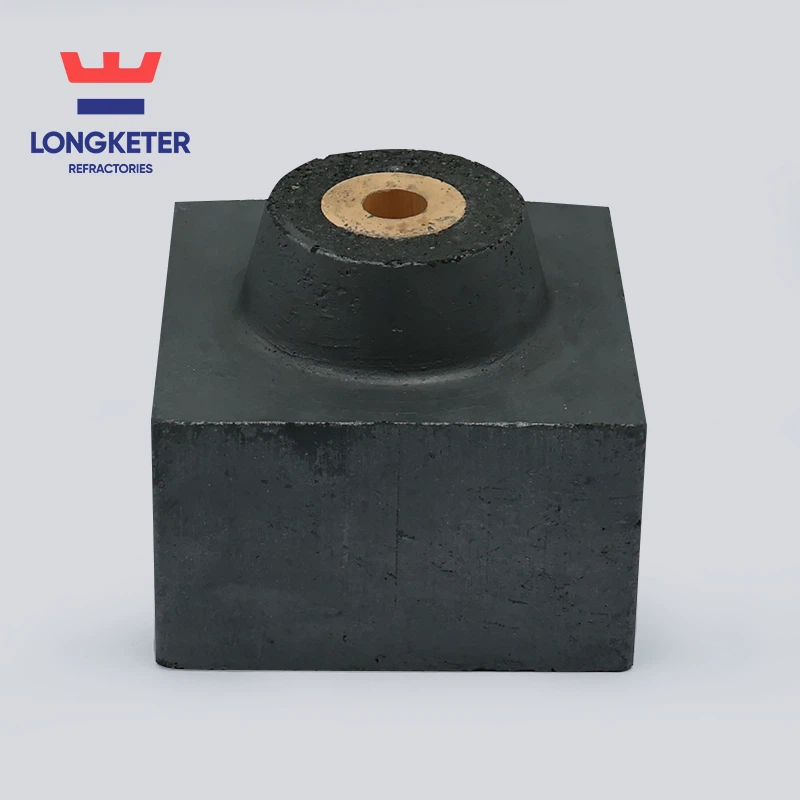
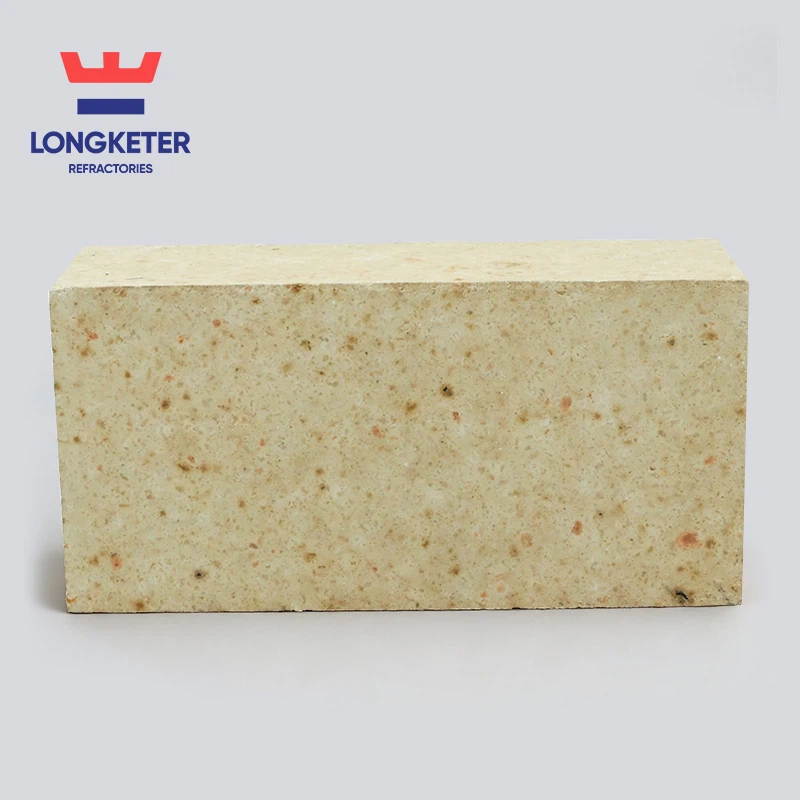
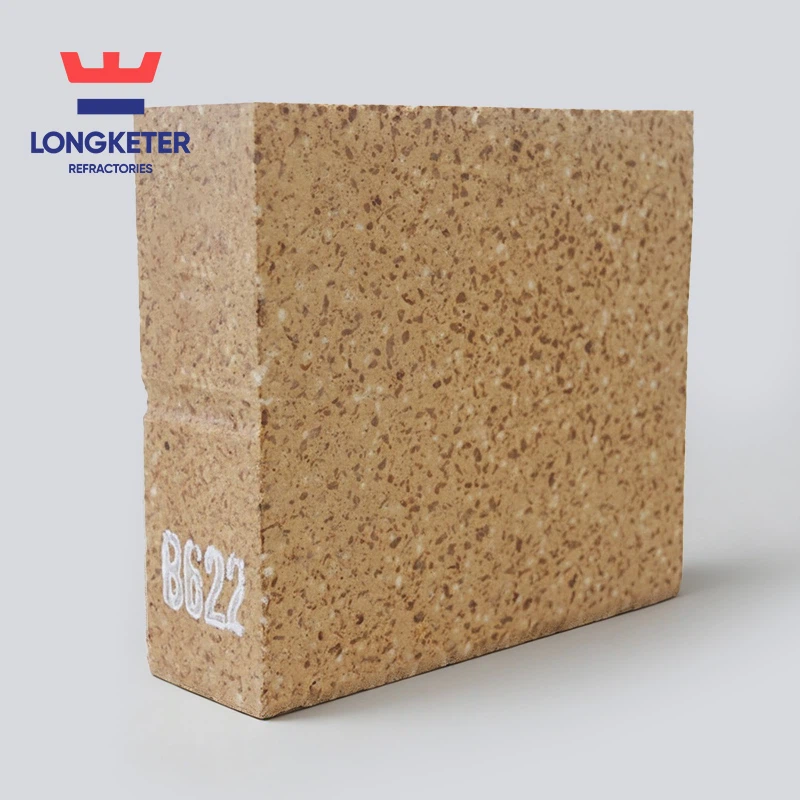
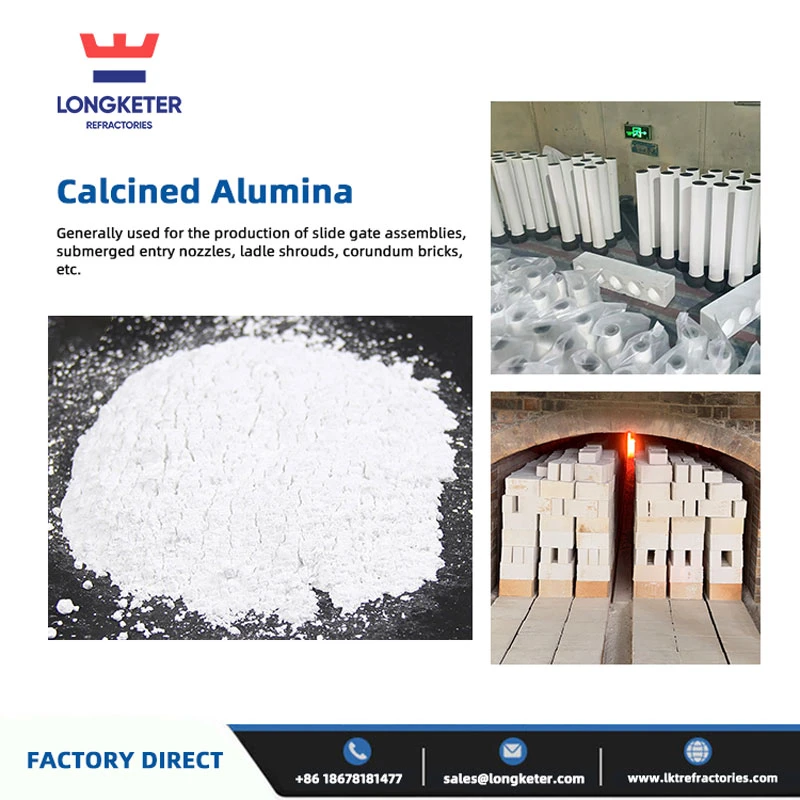
The image accompanying this article highlights several typical applications of calcined alumina in steel-related refractory production.
Slide Gate Assemblies
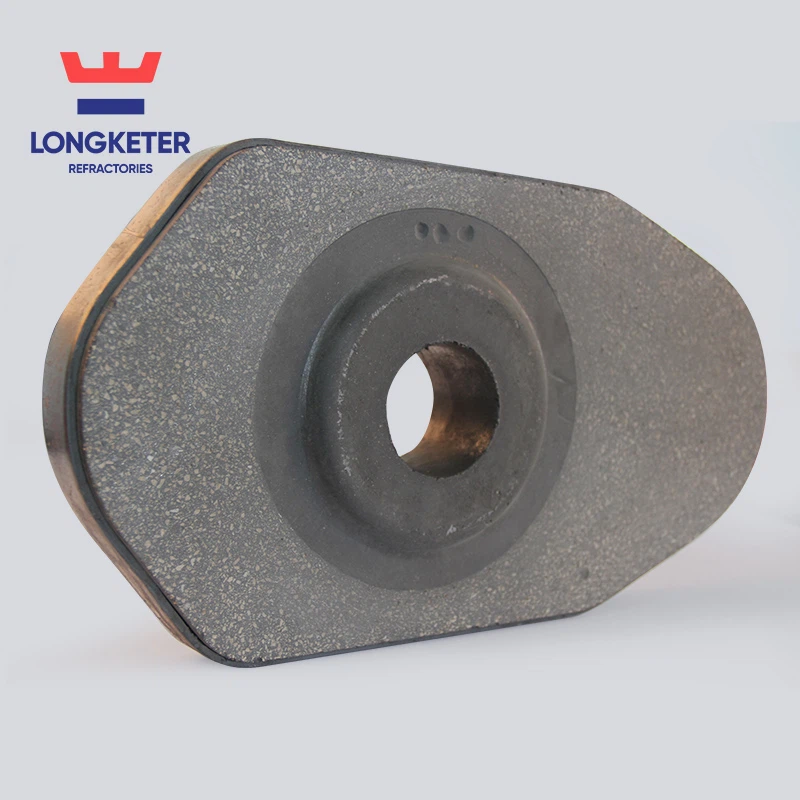
Slide gate systems are critical components in continuous casting operations. They control the flow of molten steel from the ladle and must withstand severe thermal and mechanical conditions.
Alumina-containing refractory compositions are widely used in slide gate plates and related components because the material can provide the high-temperature characteristics required in molten-metal service.
For refractory manufacturers, raw material consistency is important because variations in particle size or chemical composition can affect pressing, sintering, density, and ultimately the behavior of the finished component.
Submerged Entry Nozzles
Submerged entry nozzles guide molten steel from the tundish into the continuous casting mold. These components operate under a combination of high temperature, thermal shock, molten-steel contact, and potential erosion.
Alumina is therefore an important constituent in various refractory formulations used for nozzle production.
A suitable calcined alumina raw material can contribute to the refractory matrix and help manufacturers develop formulations designed around their specific casting conditions.
The actual performance of a submerged entry nozzle, however, depends on the complete formulation and manufacturing process rather than on a single raw material.
Ladle Shrouds
Ladle shrouds are exposed to molten steel and extreme temperature changes during casting. Their primary function is to provide a controlled path for steel flow while helping reduce unwanted exposure to the surrounding atmosphere.
Refractory producers may use alumina-based materials in these products where high-temperature stability and resistance to molten-metal interaction are required.
Stable raw material quality becomes particularly useful when manufacturing needs to remain consistent from batch to batch.
Corundum Bricks and Alumina-Rich Refractories
Calcined alumina can also be used in the production of corundum bricks and other high-alumina refractory products.
These materials are commonly selected for demanding furnace zones where resistance to heat, wear, and chemical attack is important. Depending on the formulation, alumina raw materials may be combined with other refractory minerals to achieve specific density, strength, thermal, and corrosion-resistance characteristics.
For refractory manufacturers, the objective is not simply to maximize alumina content. The more practical goal is to create a balanced microstructure suited to the operating environment.
What Should Buyers Consider When Selecting Calcined Alumina?
When purchasing calcined alumina for refractory production, buyers should look beyond the product name.
Several technical factors deserve attention.
1. Chemical Composition
Al₂O₃ content is one of the first specifications buyers normally review. Impurity levels are also important, particularly for applications where refractory performance can be affected by components such as silica, iron oxide, sodium oxide, calcium oxide, or other minor elements.
A suitable specification should be selected according to the final refractory product rather than simply choosing the highest available alumina content.
2. Particle Size Distribution
Particle size has a direct relationship with packing behavior and formulation design.
Fine alumina powder can serve a different purpose from coarser aggregate. In a refractory mixture, the distribution of different particle fractions influences packing density, porosity, workability, and the development of the final microstructure.
For this reason, refractory manufacturers should match particle size distribution with their existing production process and formulation requirements.
3. Consistency Between Batches
Consistency is often overlooked during raw material sourcing.
A refractory plant may produce thousands of components using the same basic formulation. If raw material characteristics fluctuate significantly from one shipment to another, the manufacturer may need to adjust the formulation or processing parameters.
Stable calcined alumina helps reduce unnecessary variation and makes production control easier.
For industrial buyers, a reliable supply program can therefore be as important as the nominal specification.
Calcined Alumina and Refractory Performance
The final performance of a refractory product is determined by multiple factors.
Raw material purity is one part of the equation. Particle distribution, mixing quality, forming pressure, drying, firing temperature, firing atmosphere, binder selection, and final microstructure can all influence service behavior.
For example, two refractory products may contain similar levels of Al₂O₃ but perform differently because their formulations and manufacturing processes are not identical.
This is especially relevant for steelmaking refractories. Slide gate plates, ladle shrouds, submerged entry nozzles, and furnace bricks are exposed to different operating conditions. A raw material specification that works well in one application may not automatically be the best choice for another.
Therefore, experienced refractory manufacturers typically evaluate alumina according to the complete application rather than relying on a single specification.
The Importance of Supply Reliability
For international refractory producers, raw material procurement involves more than technical quality.
Delivery stability, packaging, documentation, batch consistency, communication, and the ability to support repeat orders can directly influence production planning.
A sudden variation in raw material quality may require laboratory testing, formulation adjustment, or additional production controls. Delayed shipments can create another problem by affecting inventory planning.
This is why industrial buyers often prefer suppliers capable of providing both technical information and consistent supply.
For calcined alumina used in refractory manufacturing, a dependable supply chain can help producers maintain stable production schedules while reducing unnecessary material-related interruptions.
Supporting Modern Refractory Manufacturing
The refractory industry continues to develop toward more controlled formulations and application-specific materials. Steelmakers, meanwhile, increasingly expect refractory products to provide predictable performance under demanding operating conditions.
This creates greater pressure on refractory manufacturers to understand their raw materials in detail.
Rather than treating calcined alumina as a generic commodity, manufacturers can evaluate it according to several questions:
Is the chemical composition appropriate for the target product?
Is the particle size suitable for the formulation?
Does the material remain consistent between batches?
Can the supplier maintain reliable delivery?
Is the documentation sufficient for incoming quality control?
Can the material be integrated into the existing production process?
These questions are practical because refractory performance begins with material selection long before a finished product enters a furnace or casting line.
Applications Beyond Steelmaking
Although steelmaking is an important market for alumina-based refractories, calcined alumina is not limited to steel applications.
It can also be incorporated into refractory materials for other high-temperature industries, depending on formulation and performance requirements.
Alumina-based materials may be used in furnace linings, kiln furniture, castables, monolithic refractories, and other engineered refractory systems.
The appropriate grade and particle distribution will depend on the intended application, processing technology, and required physical properties.
For this reason, buyers should provide application details when requesting a quotation rather than selecting material solely by product name.
Longketer Refractories: Focus on Industrial Raw Materials
Longketer Refractories supplies refractory raw materials and products for industrial applications, with a focus on stable quality and reliable international supply.
Its calcined alumina is positioned for refractory manufacturers working with applications such as slide gate assemblies, submerged entry nozzles, ladle shrouds, corundum bricks, and other alumina-containing refractory products.
For industrial purchasing teams, technical specifications should be confirmed according to the intended application and production process. Factors such as Al₂O₃ content, impurity levels, particle size, packaging, and order requirements can be discussed before supply.
This application-focused approach is particularly useful for overseas buyers who need a repeatable raw material source rather than a one-time shipment.
Choosing the Right Raw Material for the Right Application
High-temperature refractory systems are engineered products. Their reliability depends on the interaction between raw materials, manufacturing processes, and actual operating conditions.
Calcined alumina provides an important alumina source for refractory formulations, but selecting the right grade requires an understanding of the finished product.
For a slide gate plate, the priorities may differ from those of a corundum brick. A submerged entry nozzle also faces a different combination of thermal and chemical conditions than a furnace lining.
The most effective purchasing decision therefore starts with the application.
By evaluating chemical composition, particle characteristics, consistency, processing compatibility, and supply reliability together, refractory manufacturers can make more informed decisions about their raw material sourcing.
Conclusion
Calcined alumina remains an important material for the production of high-performance refractories used in steelmaking and other high-temperature industries. Its role extends across slide gate assemblies, submerged entry nozzles, ladle shrouds, corundum bricks, castables, and other alumina-rich refractory systems.
For manufacturers, the key is not simply selecting a material with a high alumina percentage. Consistent quality, suitable particle characteristics, controlled impurities, dependable supply, and application compatibility all matter.
As refractory production becomes increasingly application-specific, reliable raw material sourcing will continue to be an important part of maintaining stable manufacturing and predictable refractory performance.