The advantages of clay refractory bricks are high hardness, good fire resistance, and strong earthquake resistance. However, special attention must be paid to use and maintenance to avoid problems such as breakage and sanding, so that it can exert its maximum effect and ensure high-quality work results.
Send Inquiry
Description
Technical Parameters
Clay Firebricks Custom Sizes & OEM/ODM Service
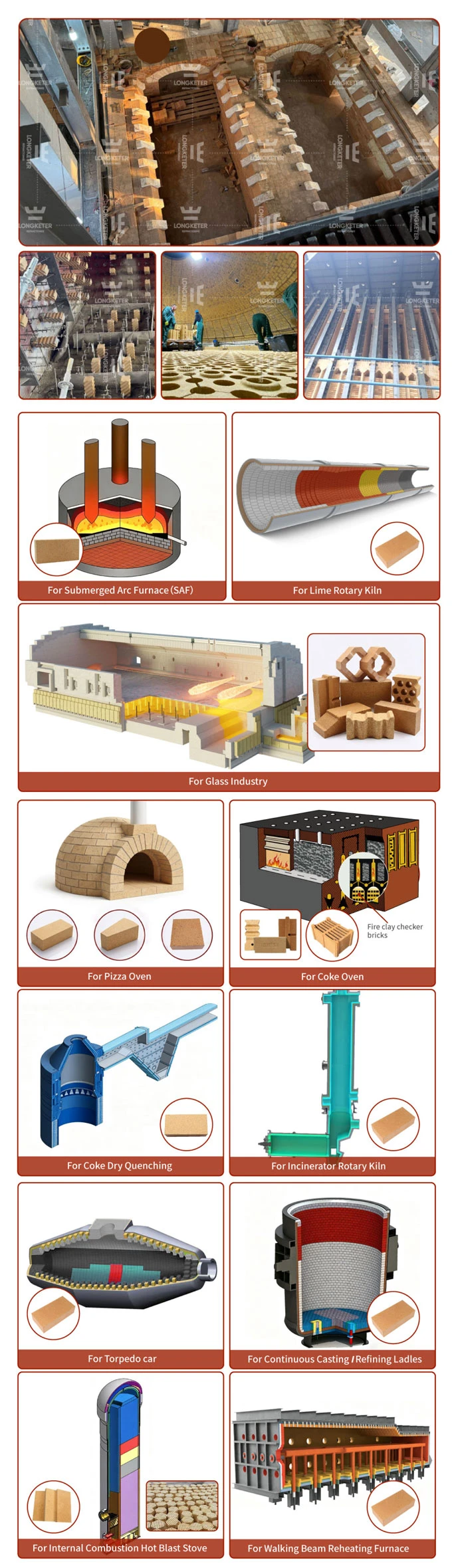
LONG KETER supplying a comprehensive range of CLAY FIREBRICKS.Alumina content in approximate 28-45% are classified to CLAY FIREBRICKS.With refractoriness ratings of SK32 and SK34, the bricks are made from a variety of raw materials, including refractory clay, sintered mullite, and other materials. These materials exhibit strong abrasion resistance, spalling resistance, and corrosion resistance. Due to their low porosity, high strength, good resistance to thermal spalling, abrasion resistance, and creep resistance, Refractory clay bricks are widely used in the linings of coke ovens, glass furnaces, cement rotary kilns, lime kilns, various incinerators, reheat furnaces, and other equipment.
High-quality fireclay bricks (42% Al₂O₃, 1760°C) for blast furnace linings; TUV, RoHS, ISO9001, ISO45001, and ISO14001 certified.
High-strength fireclay bricks for coke oven construction (Cold Crushing Strength ≥25 MPa); large-scale production capacity and fast delivery.
High-density fireclay bricks for glass furnace regenerators (Density: 2200 kg/m³, low porosity: 18%, long service life).
Heavy-duty refractory bricks for ladle and mold backing; high thermal shock resistance; bulk orders accepted.
Low-creep high-alumina refractory bricks for hot blast stoves; 100% on-time delivery.
The main application for CLAY FIREBRICKS are listed below:
Metallurgical Industry: Fireclay bricks are used for tundish linings in hot metal runners and as checker bricks in the regenerators of hot blast stoves. Aluminous bricks are also used in furnace flues; customers sometimes refer to these as acid-resistant fireclay bricks. Glass Industry: Fireclay bricks are used in the lower sections of glass furnace regenerators and checkerwork. They are suitable for zones with moderate temperature requirements. Their excellent acid resistance helps extend the service life of glass furnaces. Custom fireclay bricks are available.
Coking Industry: Fireclay bricks play a vital role in the coking industry. They are preferred for furnace components subject to temperature fluctuations and relatively lower operating temperatures-such as furnace doors, ascension pipe linings, small flue linings, furnace roofs, regenerator walls, and checker bricks. Using these bricks in coke ovens is both economical and efficient. Steelmaking Industry: Fireclay bricks are crucial for various parts of blast furnaces, including the furnace throat, stack (body), tuyere zone, and hearth. These bricks must withstand high-temperature abrasion and maintain impressive strength at room temperature, offering superior performance compared to standard fireclay bricks.
Iron, Steel, and Smelting: They perform exceptionally well in iron ladles, hot metal runners, blast furnaces (throat, hearth, and tuyere zones), and hot blast stove systems. We provide high-strength, wear-resistant, and customized solutions that ensure structural stability in high-temperature environments.
Glass and Coking: With excellent acid resistance and thermal shock resistance, they are the ideal choice for glass furnace regenerators, coke oven doors, ascension pipes, and regenerator walls, ensuring cost-effective operation amidst complex temperature fluctuations.
Building Materials and Kilns: Widely used in kaolin tunnel kilns and lightweight aggregate rotary kilns as refractory linings or auxiliary protective layers, effectively extending the equipment's lifecycle.
Building Materials Industry:Widely applied in kilns with relatively low firing temperatures, such as kaolin tunnel kilns and lightweight aggregate rotary kilns. In addition, customers can use this type of brick as a protective layer alongside the primary working layer, which contributes to the kiln's durability and extended service life.
FAQ
Q1: Are you manufacturing?
A1:LONG KETER is a manufacturer with more than 16 years of experience in refractory industry, welcome to visit us.
Q2: Are there free samples?
A2: Yes, free samples are provided. The partners should bear the shipping cost. Please tell us which product you are interested in for more details.
Q3: Can I customize it?
A3: Yes, LONG KETER factory supports customized refractory bricks in size, shape, chemical composition, etc. There are more than 20 engineers OEM/ODM ready to customize solutions for you.
Q4: I have a project, I want the whole solution, can you prove it?
A4: No problem, we have a professional technical team and have very rich experience in the refractory industry, just need you to send us some requirements of your project, we can provide one-stop service from solution.