Longketer Refractories supplies sintered magnesia alumina spinel for demanding refractory applications in iron and steel metallurgy and cement production, with a focus on high purity, stable quality, and reliable supply.
In high-temperature industries, refractory materials are expected to maintain their structural stability while facing thermal cycling, chemical reactions, mechanical wear, and prolonged exposure to elevated temperatures. For refractory manufacturers, choosing a suitable raw material is therefore an important part of developing reliable linings.
Sintered Magnesia Alumina Spinel is an established refractory raw material used in selected high-temperature applications, including refractory systems for rotary kilns in iron and steel metallurgy and cement production. Its role is not simply determined by the material itself; particle size, formulation design, processing conditions, and the actual working environment all influence the performance of the finished refractory product.
Longketer Refractories supplies sintered magnesia alumina spinel with an emphasis on high purity, stable quality, and reliable supply, supporting refractory manufacturers that require consistent raw materials for industrial production.
Why Sintered Magnesia Alumina Spinel Matters
Rotary kilns operate under continuously changing thermal and mechanical conditions. Depending on the production process, the refractory lining may encounter high temperatures, abrasive materials, chemical reactions, and repeated heating and cooling.
This creates a demanding environment for refractory linings.
A suitable refractory raw material needs to work effectively within the overall formulation. For manufacturers, the objective is usually not to find one material that solves every problem, but to select raw materials that complement each other and meet the requirements of the final refractory product.
Magnesia-alumina spinel is valued in refractory technology for its combination of high-temperature stability and resistance to aggressive service environments. When properly incorporated into a refractory formulation, it can contribute to the overall performance and durability of the lining.
The actual result, however, depends on the complete refractory system.
That is why raw material consistency is an important consideration during procurement.
Sintered Magnesia Alumina Spinel for Rotary Kilns
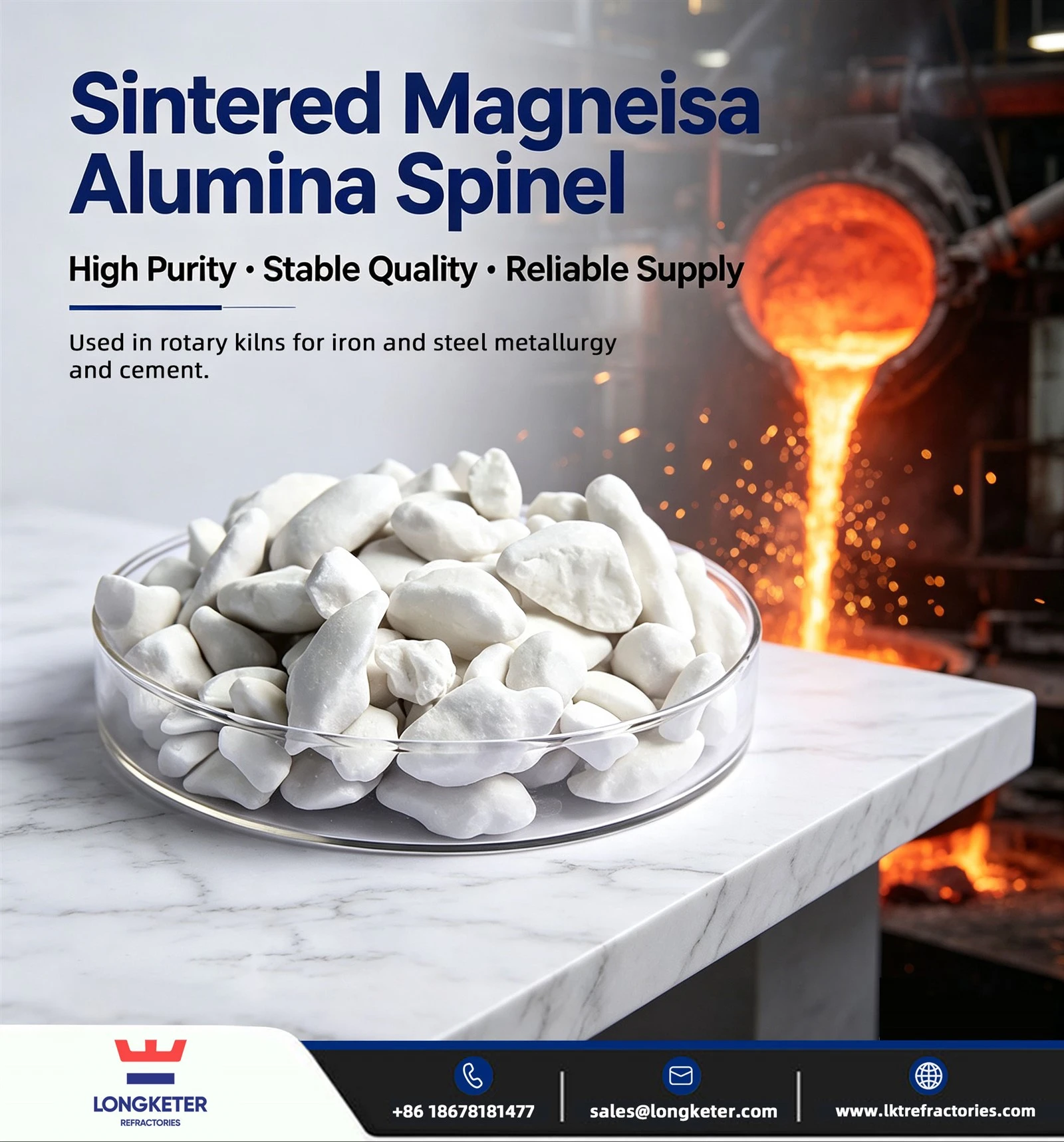
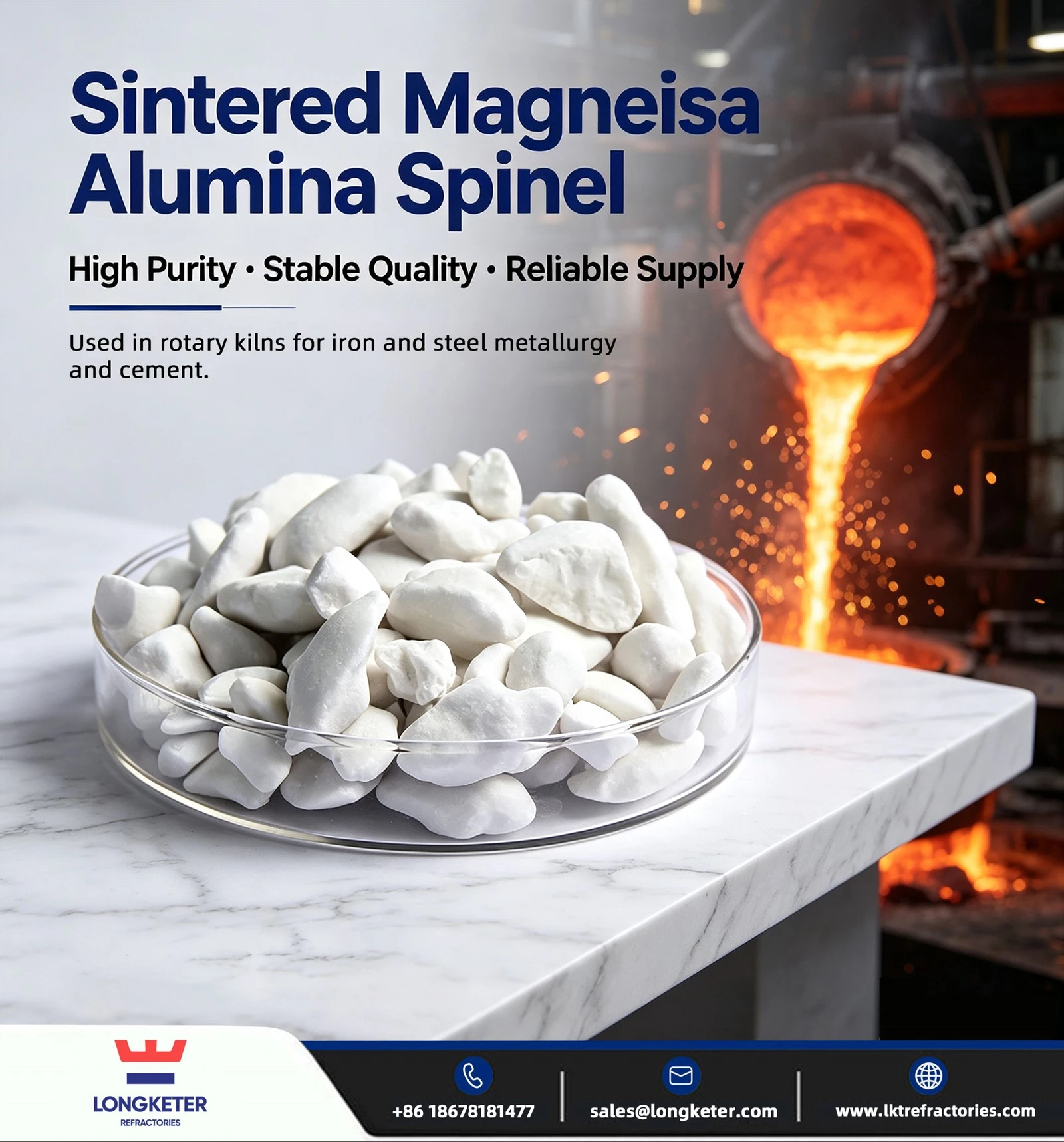
The product shown in the image is sintered magnesia alumina spinel, supplied for refractory applications associated with high-temperature industrial equipment.
One of its highlighted applications is rotary kilns used in iron and steel metallurgy and cement production.
Rotary kiln conditions can vary significantly according to equipment design, process parameters, feed materials, temperature profile, and operating cycle. Refractory manufacturers therefore need to consider the intended application when selecting spinel raw materials.
A properly selected raw material can help manufacturers maintain better control over their refractory formulations.
For example, particle size distribution can influence packing and processing characteristics, while chemical composition and material consistency need to be considered alongside other components in the formulation.
For this reason, buyers should evaluate sintered spinel based on their own technical specifications rather than selecting a material solely by its general product name.
Stable Quality Is Important for Refractory Production
For industrial refractory manufacturers, consistency between batches can be just as important as the general properties of a raw material.
Imagine a production line running the same refractory formulation week after week. If the characteristics of one key raw material change significantly from batch to batch, production teams may need to make additional adjustments. That can complicate quality control and create unnecessary uncertainty.
Stable raw materials provide a more predictable foundation for manufacturing.
Longketer Refractories focuses on supplying sintered magnesia alumina spinel for industrial refractory applications with stable quality and dependable supply.
The material can be evaluated according to the customer's production requirements, including the intended refractory application, particle-size requirements, packaging specifications, and purchasing volume.
This application-oriented approach is particularly relevant for customers purchasing refractory raw materials for continuous production.
Applications in Iron and Steel Metallurgy
Iron and steel production places considerable demands on refractory materials.
High-temperature processing, molten materials, slag interaction, thermal cycling, and mechanical impact can all contribute to refractory wear. Different sections of industrial equipment may also require different refractory solutions.
Sintered magnesia alumina spinel can be considered as a raw material for refractory formulations used in suitable high-temperature zones.
For refractory engineers, the selection process should start with the operating conditions.
Important considerations may include:
Working temperature
Chemical environment
Abrasion conditions
Thermal cycling
Refractory installation method
Required service performance
Existing refractory formulation
By evaluating these factors together, manufacturers can determine whether a particular spinel grade is suitable for their product.
The same principle applies when developing refractory materials for cement production.
Applications in the Cement Industry
Cement manufacturing also involves demanding high-temperature equipment, including rotary kilns.
Refractory linings inside these systems must cope with thermal loads as well as chemical and mechanical stresses associated with the production process.
For cement-industry refractory manufacturers, raw material selection is closely linked to the specific working conditions of the kiln.
Sintered magnesia alumina spinel for cement rotary kilns can be evaluated as part of refractory formulations designed for appropriate high-temperature service conditions.
Rather than relying on a single material property, manufacturers generally need to consider the complete formulation and the relationship between different raw materials.
This is particularly important when refractory products are designed for long operating cycles where lining stability and resistance to wear are important purchasing considerations.
What Should Buyers Consider When Sourcing Spinel?
Selecting a refractory raw material is a technical purchasing decision.
Price is naturally important, but it should not be the only consideration. A material that does not match the production process can create additional costs during manufacturing or service.
Before purchasing sintered magnesia alumina spinel, buyers may want to review several points.
Chemical and Physical Specifications
The supplier should provide relevant technical specifications for evaluation against the customer's refractory formulation.
Different refractory products may have different requirements, so specifications should be reviewed according to the intended application.
Particle Size
Particle size is another important consideration.
Different refractory formulations use different grain-size distributions. Buyers should confirm that the available sizing is appropriate for their production process.
Batch Consistency
For long-term production, consistency between batches can make quality control easier.
A stable supply specification also helps manufacturers establish more predictable purchasing and production procedures.
Application Suitability
The material should be evaluated according to the actual working conditions of the refractory product.
A spinel suitable for one formulation may not necessarily be the best choice for another.
Supply Capability
For international refractory manufacturers, reliable delivery is also part of supplier selection.
A stable supply chain helps manufacturers maintain production schedules and reduce procurement uncertainty.
A Practical Approach to Raw Material Selection
There is no single refractory raw material that can be considered ideal for every application.
Instead, refractory performance comes from the interaction of material selection, formulation design, manufacturing process, installation, and operating conditions.
This is why Longketer Refractories emphasizes communication with customers before long-term supply arrangements are established.
Customers can provide information about their intended application and technical requirements. The material can then be discussed in terms of suitable specifications, particle size, packaging, and supply volume.
For new customers, sample evaluation can also be considered before moving to larger orders.
This approach allows refractory manufacturers to make purchasing decisions based on their actual production needs.
High Purity, Stable Quality and Reliable Supply
As industrial processes continue to place demanding requirements on refractory linings, raw material quality remains an important part of refractory manufacturing.
Sintered Magnesia Alumina Spinel provides refractory manufacturers with a material option for selected applications in rotary kilns and other high-temperature systems, particularly within iron and steel metallurgy and cement-related refractory production.
Longketer Refractories focuses on three practical priorities: high purity, stable quality, and reliable supply.
For refractory manufacturers evaluating new raw material suppliers, the most useful starting point is a comparison between the supplier's technical specifications and the requirements of the finished refractory product.
Longketer Refractories welcomes inquiries from international refractory manufacturers and industrial buyers looking for sintered magnesia alumina spinel for rotary kiln and other suitable high-temperature refractory applications.
Email: sales@longketer.com
Website: www.lktrefractories.com
Tel: +86 18678181477