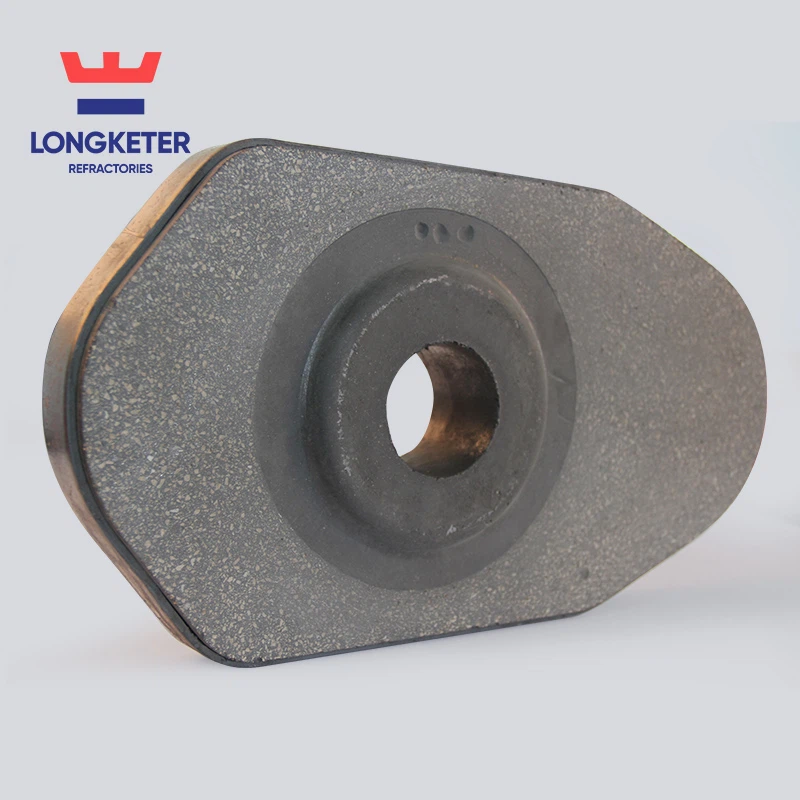
The Multi-Million Dollar Question: Are Your Nozzles a Cost or an Investment?
If you manage a continuous casting line, you know the numbers by heart: cost-per-ton, sequence length, and overall equipment effectiveness (OEE). But how often do you trace these KPIs directly back to a single, critical component: the tundish nozzle?

For too long, nozzles have been treated as a simple consumable. This mindset is costing your plant real money. Every unplanned stoppage to replace a failing nozzle isn't just a minor delay; it's a cascade of financial losses:
- Lost Production: A single stop can cost thousands in unrealized output.
- Energy Inefficiency: Reheating and restarting the process consume massive, unplanned energy.
- Labor Diversion: Your skilled team becomes a reactive maintenance crew, not a proactive optimization unit.
- Quality Variability: An eroded nozzle disrupts molten steel flow control, leading to slag entrapment and inconsistent steel quality.
The data is clear: the path to superior OEE isn't always a massive capital investment. Often, it's about optimizing the components that work the hardest. It's about turning your tundish nozzles from a cost center into a strategic asset.
The Core of the Problem: Why Standard Nozzles Fail Under Marathon Conditions
The primary enemy of nozzle longevity is erosive wear. As molten steel flows at high temperatures, it mechanically and chemically attacks the nozzle bore. Standard nozzles, with lower zirconia purity, have a more porous microstructure. This porosity is a foothold for erosion, leading to:
- Bore Widening: An enlarged bore accelerates steel flow, making precise control impossible and ending the sequence.
- Clogging: Micro-cracks and rough surfaces trap inclusions, building up clogs that disrupt flow.
- Catastrophic Failure: Thermal shock from temperature variations can cause cracking in sub-standard materials.
The industry has long known that Zirconia (ZrO₂) is the answer. But not all zirconia is created equal. The debate between 75-90% purity and >94% high-purity zirconia is the defining choice between a good sequence and a record-breaking one.
Our internal metallurgical analysis, based on field data from over 50,000 hours of casting, reveals a stark contrast. While standard nozzles might reliably achieve 8-hour sequences, they consistently fall short when pushed beyond 12 hours. The performance gap isn't linear; it's exponential after the critical 15-hour mark, where the superior density of >94% ZrO₂ becomes non-negotiable.
The 2025 Benchmark: Material Purity Meets Surface Intelligence
Selecting a nozzle with >94% ZrO₂ is the foundational step. But the frontier of performance has moved to the surface. Leading plants are now leveraging engineered surface treatments that act as a "force multiplier" for the base material.
These are not mere coatings; they are integrated performance layers:
- Functional Gradient Ceramics: We engineer a microscopic, layered structure on the nozzle's critical wear zones. This layer is progressively richer in corrosion-resistant minerals, creating a shield that sacrifices itself slowly, preserving the core nozzle integrity far longer than any homogeneous material.
- Reactive Glazing: Our proprietary glaze does more than just smooth the surface. It is chemically formulated to create a non-stick, non-wetting interface with molten steel and slag. This drastically reduces the initiation points for clogging, maintaining a pristine, predictable bore diameter throughout the cast.
- Data-Driven Design: We don't sell a one-size-fits-all product. Using computational fluid dynamics (CFD) models calibrated against our field data, we can slightly tailor the internal geometry of our nozzles for specific steel grades. This optimizes flow dynamics, minimizes turbulence, and further enhances lifespan.
The Bottom Line: Translating Technical Specs into Your Financial Statements

What does this engineering superiority mean for your plant's controller? It translates directly into measurable financial gains.
Performance Metric |
Standard Nozzle (80-85% ZrO₂) |
Long Keter Zirconia Tundish Nozzle (>94% ZrO₂ + Treatments) |
Impact |
| Avg. Sequence Length | 5-8 heats | Customizable | Controllable Production Uptime |
| Cost-Per-Ton (Nozzle) | Baseline | 15-30% Reduction | Direct Margin Improvement |
| Quality Rejection Rate | Baseline | Up to 10% Improvement | Reduced Waste & Rework |
Case in Point: From Theory to Practice
A mid-sized steel plant in Europe was struggling to consistently exceed 7-sequence heats. Their cost-per-ton was creeping up, and unplanned downtime was eroding morale.
After a full audit, they switched to our Long Keter Zirconia Tundish Nozzle. The results, published in their internal continuous improvement report, were clear:
- Achieved a plant-record 22-sequence cast within three months of adoption.
- Reduced nozzle-related stoppages by over 70% in the first year.
- Reported a 22% decrease in consumable cost-per-ton, attributing it directly to the extended nozzle life and reduced downtime.
Their production manager noted: "We stopped thinking about nozzles as a commodity to be purchased and started viewing them as a technology to be leveraged. The ROI was undeniable."
Zibo Long Keter New Materials Co., Ltd.
Tel: +86-533-2808856
Mob/Whatsapp :+8618678181477
Email: sales@longketer.com
No. 6, Xinhuan East Road, Zhangdian District, Zibo, Shandong, China
-
 Tundish Metering NozzleLong Keter manufactures a comprehensive range of zirconia based TUNDISH METERING NOZZLE used for
 -
 Refractory Quick-replace Tundish NozzlRefractory quick-replace tundish nozzle can improve the production efficiency and safety of steel
 -
 Refractory Zirconia NozzleZirconia nozzleD features:1. Excellent high temperature resistance;2. Strong corrosion
 -
 Tundish NozzleZirconia nozzleD features:high strength, high hardness, high corrosion resistance, and excellent
 -
 Submerged Entry NozzleSubmerged Entry nozzle is refractory nozzle which help molten steel flow from Tundish to Copper
 -
 Zirconia NozzleZirconia nozzles are employed mainly in the casting industry to facilitate the flow and
 -
 Exchangeable Tundish NozzlesTundish exchangeable nozzle is also called exchangeable tundish nozzles. It is new developed