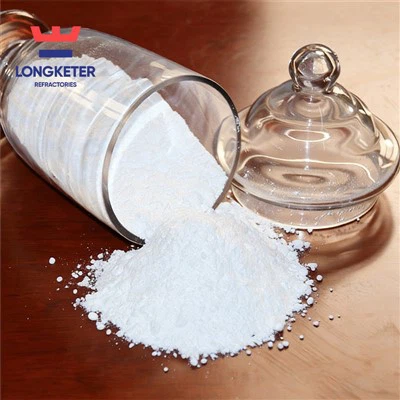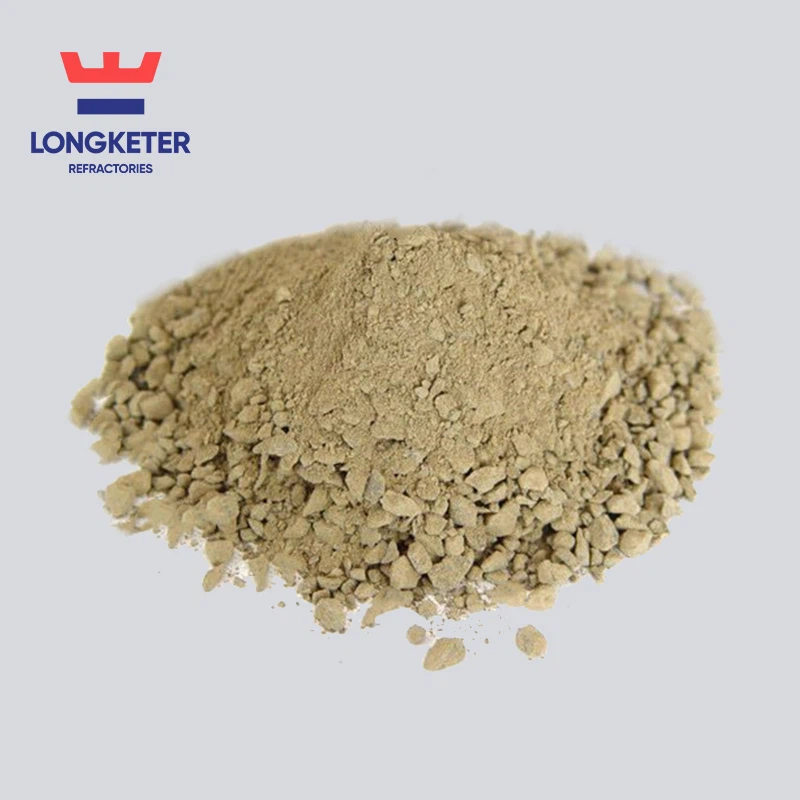


Refractory mortar is binding material between refractory blocks or bricks.
Refractory Mortar is a specially-engineered blend of specific cements and aggregates giving the mortar unique heat-resistance and thermal characteristics for use in high-temperature applications such as inside fire pit rings, setting chimney clay flue liners, parging a smoke chimney chamber, and setting fire bricks
For different blocks, various types mortar are applied. The mortar must match refractory blocks on refractoriness and alkali or acid resistance as much as possible.
Types: Clay mortar, high alumina mortar, magnesite mortar, corundum chrome mortar, special mortar for insulation blocks and ceramic fiber products etc.
Particle size: 0-0.5 mm
Application: Laying fire blocks and patching
Material: high alumina bauxite, corundum, magnesite, clay as aggregate, calcium alumina cement are applied for alumina mortar as binding agent, additives are added to meet different demands. Water, Sodium silicate, Phosphate acid or Boric acid are added accordingly to mix the mortar in field.
Generally refractory mortar is packaged in 25 kgs bags then on wooden pallets in dry situation. This could be blended and applied in field when installation is needed. Some clients prefer to finished mortar packaged in barrels, it could be used directly at field, but validity will be within 6 months or shorter, to keep good performance.
Monolithic refractories refers to unshaped refractories. It could be moulded or can be given any shape as per requirement.
Monolithics consists of graded refractory aggregates, binding agent, fillers & special additives for modification of properties
Types of monolithic refractories:
Classification of monolithic refractory is generally according to the operation/ installation method. There are types listed as below:
1. Trawling and pouring, sometimes with vibration-- castables
2. Ramming- Ramming mass
3. Gunning- Gunning mass/mix, castable
4. Spraying together with hammer- plastic refractory
Aggregates of monolithic refractories generally include kaolin flint, high alumina bauxite, tabular alumina, white fused alumina, dense mullite, dead burnt magnesite etc. Aggregates are main contents of monolithic, they are mixed according to certain proportions in different particle size.
Binding agent are different for different monolithic refractory. For alumina castable, it's generally high alumina cement, water or Sodium silicate. For plastic refractory, Phosphate acid is generally applied. For magnesite ramming and gunning mass, Boric acid is widely used as binding agent.
Properties of monolithic refractories generally including chemical composition, bulk density, cold crushing strength after 110 ℃ drying and hot crushing strength, cold rupture strength after drying and hot rupture strength, refractoriness under load 0.2 MPa etc.


Hot Tags: high temperature refractory mortar, China high temperature refractory mortar manufacturers, suppliers, factory, high alumina castable refractory, High Temperature Refractory Mortar, Dry Ramming Mass, cement castable, Gunning Mass, high alumina cement